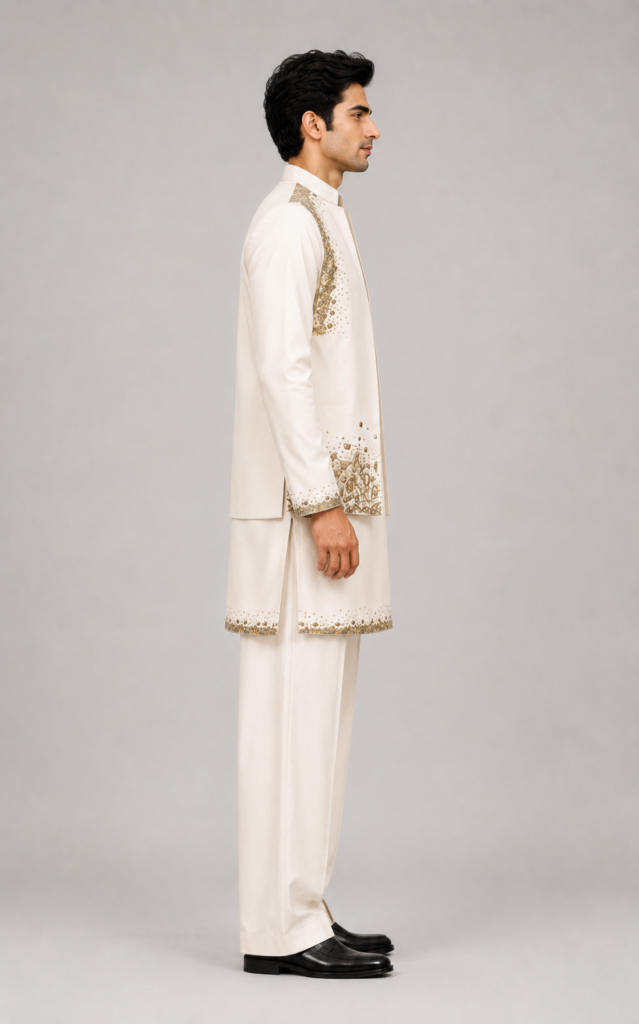
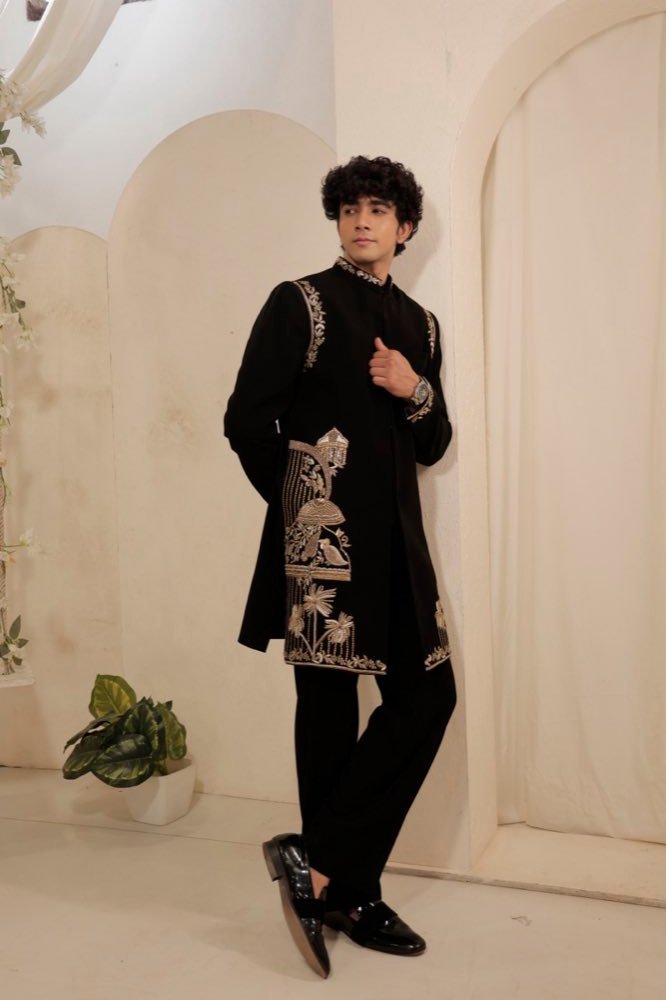
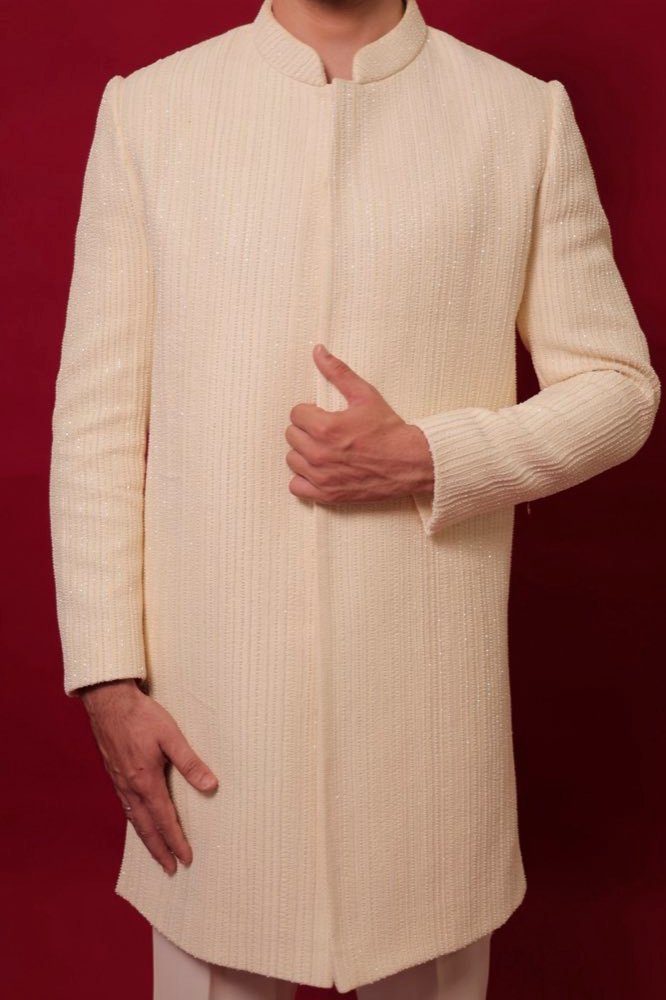






The cloth
A bolt is chosen before a single measurement is taken. It decides the cut, the lining and how long the making will take.


Six cloths. Six articles. One garment at a time,cut for one person and no one else.
The making
A bolt is chosen before a single measurement is taken. It decides the cut, the lining and how long the making will take.
A paper pattern is cut for one body and kept. Nothing is graded from a block.
Horsehair and camel hair, basted in by hand, so the chest holds its shape for twenty years instead of two.
Three, at least. The first on a half-made garment, the last close enough to wear out of the room.
Buttonholes, cuffs and linings closed by hand. Then the garment is pressed, hung, and left alone for a day.
The hand of the cloth
Cashmere at fifteen microns, silk reeled in one long filament, wool spun to Super 150s. Held up, these cloths do not stand — they fall, and keep falling. That is the whole difference, and it is why the bolt is chosen before a single measurement is taken.
Cloth that falls needs a canvas that lets it. Horsehair padded in by hand, a lapel rolled rather than pressed, a shoulder left alone. Nothing is fused, because fusing would hold the cloth still — and holding it still is the one thing you must not do to it.
Your paper pattern is cut once and kept at the studio — never graded, never used for anyone else. Three fittings, the studio on the telephone, and the cloth remembered for the next piece. What you are given back is not a size. It is a garment that fits one person, and that person is you.
A piece you did not so much buy as commission.
The books we keep
Every one of these sits in the studio at Indore. Come in and turn the pages — the bolt is chosen before a single measurement is taken.
Trivero, 1910. A mill that grew into a house, spinning and weaving its own Australian and New Zealand wool in Biella.
Brussels, 1938. Woven in Huddersfield and finished in Belgium, known for very high counts and its jewelled cloths.
Quarona, 1924. The largest buyer of fine cashmere in the world, and the one house that still works vicuña.
Biella, 1663. The oldest wool mill still held by the family that began it, now in its thirteenth generation.
Biella, 1865. Merino from its own farms in New Zealand, carried through to the finished cloth.
Italian-milled suiting and shirting under the Vercelli name, in Australian merino up to 130s.
Suiting, shirting and dress material under the Donatella Italia label.
The cloth
A bolt is chosen before a measurement is taken. These six are what the house keeps on the shelf; anything else is found for you and woven to order.
The floor
Appointment
An hour at the studio, the bolts on the table, and a drawing made before anything is cut. Tell us when suits you and the studio will call to fix the hour.